Showing posts with label Gaming. Show all posts

Wednesday, September 5, 2012

The Last Story Review


Japanese RPGs are currently experiencing something of a crisis. It’s been many years since the likes of Final Fantasy VII, games which featured turn-based battles and largely linear narratives, were among the most popular video games around. Their successors have arguably been less influential than Western role-players like the Mass Effect and Elder Scrolls games, which sport real-time combat and tell more open-ended tales. The Last Story, which comes courtesy of Final Fantasy creator Hironobu Sakaguchi and his Mistwalker development studio, draws from both traditions and is one of the most satisfying Japanese RPGs I’ve played in a very long time.

IT’S NOT THE SIZE THAT COUNTS… 


One of the best things about The Last Story is that it’s small. By that I don’t mean that it’s boring or lacking in content. I mean that it’s focused; it knows its strengths and sticks to them. Take the setting, a verdant seaborne fiefdom called Lazulis Island. It is here that we’re introduced to Zael, a sword-wielding mercenary with a kind heart and a predictably stupid haircut. Although the story takes Zael and his band of merry mercs to some faraway places, most of their time is spent tromping round the island working for the local nobility in hopes of improving their social status.

The main storyline, which involves a power-hungry despot, an exiled race of blood-eyed humanoids, and a lady most fair, is a good one, but what really makes it sing are the grace notes, the in-between chapters that explore the far corners of Lazulis Island in often delightful detail. In one excursion, Zael and company help a local shopkeeper rescue his wife from a haunted mansion. In another, Zael does battle in the local coliseum only to find that the kingdom’s knights are throwing fights to him due to his favor with the ruler of the island. The Last Story tells a tale as exciting as anything in the genre, but we’ve played through too many of those to care without something more. It’s the little things, like the way Zael can smack his head against a low-hanging signpost or overhear conversations between pairs of people talking in the street, that give meaning the bigger ones, and The Last Story is a game that cares about the little things.

This fine shading extends to the cast of characters, who by most metrics lack distinction. Zael is an even-tempered nice guy of a leading man. The leader of the group, Dagran, is a stern patriarch. We’ve also got the bawdy, duel-wielding Syrenne, petulant mage Yurick, and soft-spoken healer Mirania. We’ve seen this group before, but as with the story, they’re brought to life by the little moments. The group talks to each other as they leap into battle, and the things they say are usually diverting enough to be worth having said. The voice cast of British actors is excellent, and the script gives them enough different tones to work with that they needn’t feel embarrassed by the credit. The Last Story is a character-driven game, so it’s fortunate that the characters are worthy of it.

Despite these accolades, the The Last Story’s story is far from perfect. It has its share of RPG clichés, plot-holes, and at least one baffling character about-face, but it’s filled out with just the right details in just the right places that it makes one want to think well of it. The musical score by Nobuo Uematsu is lovely; the main theme summons the kind of elegiac mood once reserved for the better Final Fantasy games. The art team provides a visual style to match it, bathing the game world in a lazy late afternoon haze. I even came around to the obtrusive narrator, who fills in details of the story we only occasionally need to know in a way that started off as annoying and at some point became charmingly dopey. The Last Story is a very easy game to like, and for that reason I found myself willing to look past some of its shortcomings.

…IT’S HOW YOU USE IT. 


This quality was helpful when it came to the battle mechanics, since the game’s ambitious combat system sometimes falls short of its lofty goals. Like most modern RPGs, combat in The Last Story unfolds in real-time, but the game avoids one of the most ridiculous images of modern gaming, that of a group of characters standing immobile around an enemy and whacking it while little numbers pop up over its head. Combat in The Last Story is dynamic, with a lot of running and climbing and aiming involved. It has its faults, but it’s still the best attempt I’ve seen by a Japanese RPG to use real-time combat, and is frequently a lot of fun.

When it comes to fighting, one of the game’s best innovations is to eliminate random, and even semi-random, battles entirely. There are no fights in this game that you cannot fight. Each one is planned out ahead of time, meaning that the developers can set up the geography, enemy formation, and available implements to ensure that each encounter is as interesting as possible. Players take control of Zael, who has a variety of techniques he can use to defeat his foes. Running up to an enemy will make Zael auto-attack. He can also manually aim his crossbow, take cover behind conveniently placed debris, command his allies to use their specialty abilities, diffuse magic circles left by spells to cause a wide variety of effects, and quite a bit more. The game introduces new techniques gradually right up until the end, so there’s usually something new to play around with.

What’s better is that the game actually makes you use the techniques it so generously provides, often in rather creative ways. I remember the moment I realized I was actually going to enjoy the fights in this game. My party was battling a doppleganger monster who fought us from the other side of a mirror, replicating my every move. Auto-attacking did nothing, since the monster would just copy me and our swords would meet in mid-swing. I had to order Yurick, my mage, to cast a fire spell on the floor near the monster, which left a heat residue that distracted it long enough for me to land a blow. I was very, very happy to realize that I wasn’t going to be able to win every fight in the game by thwacking the enemy to death.

Although there are times when that’s the case, particularly when the fights have large numbers of combatants and there’s too much going on to focus on strategy. In these moments, the battles can become frustrating and chaotic, but most of the time they’re intelligently laid out and, at their best, play more like miniature puzzles where someone dies at the end. If RPGs must have real-time combat, I strongly endorse this game as the model to build upon.

Buying weapons and armor outside of combat is a straight-forward affair, not so simple that there’s no strategy involved but not so complex that you’ll weep openly whenever you have to upgrade your equipment. Money is available but not absurdly plentiful, so you’ll actually have to prioritize what you want to buy and when you want to buy it. Plus, shopping will give you the opportunity to wander around Lazulis City, the game’s central hub and a memorable medieval metropolis packed with side-quests, collectibles, and a bustling torrent of NPCs. It feels lived-in and alive, vast in size but really residing in the sun-touched corners and windy side-streets. It’s a vibrant place with a surprise around the corner, and somewhere I’d love to see the industry return.

Castlevania: Rondo Of Blood Review


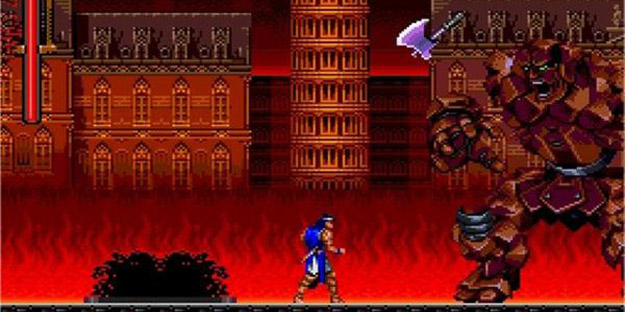
Ah, 1993.  A time when men were men, women were women, and video games pounded players into submission until they were sobbing uncontrollably into the armrests of their easy chairs.  Castlevania: Rondo of Blood, the tenth game in Konami’s venerable Castlevania franchise, is very much of this era.  The game was originally released on the TurboGrafx-16, a home gaming console popular in Japan but which never really got a foothold in the American market.  For this reason, Rondo of Blood went unplayed by American Castlevania fans for many years.  It is now available, among other places, on the Wii’s Virtual Console, and audiences everywhere have the opportunity to crumble beneath its difficulty.

Because Castlevania: Rondo of Blood is hard.  You play as Rhictor Belmont, of the Transylvania Belmonts, who needs to make his way through Dracula’s castle to rescue his kidnapped fiancé.  The game is broken up into several side-scrolling stages, and they are merciless.  Much of the difficulty comes from Rhictor’s inability to maneuver himself.  You can’t, for example, do much to control your jumps once you’re in the air, a problem for a game which requires microscopically precise platforming.  Enemies take off a lot of life per hit, and opportunities to recharge are rare.  Rhicter fights Dracula’s army of monsters armed with a bevy of sub-weapons and his trusty whip, but the whip has a limited range of movement and the sub-weapons often aren’t as powerful as they need to be.

The result: you’ll die a whole Hell of a lot before you finally conquer whatever obstacle has been giving you grief.  But once you do, you’ll feel terrific.  Rondo of Blood operates on a risk-reward system taken from an older school of game design, one which treated video gaming more as an ordeal to get through than as an experience to savor.  The game says to the player “Beat me if you can” and the player either rises to the challenge or leaves to go do something useful with their time.

For players who stick it out, the game rewards them with a flashy production and generous extras.  Rondo of Blood has a bright, clean look and a bountiful visual imagination.  The art team clearly enjoyed themselves in designing all manner of nasty monsters to throw at you, and even as they tear you to shreds for the umpteenth time you can’t help but appreciate the variety.  The elaborate boss battles are especially distinctive, not to mention especially difficult.  Many of the designs are so solid that they were reused for the game’s more famous sequel, Symphony of the Night.

The connections between Rondo of Blood and Symphony of the Night don’t stop at the visuals.  Rondo of Blood is notable for being the first Castlevania game to not be entirely linear.  You still traverse levels one at a time, but many of those levels have more than one exit, and each of those exits lead to different stages.  Eventually, all roads take you to Dracula, but how you get there is up to you.  In Symphony of the Night, Konami famously tossed off the level-by-level format and made Dracula’s castle one giant interconnected environment.  Rondo of Blood is an important step on that path.

There’s also an additional playable character, named Maria, to whom you gain access after rescuing her in one of the game’s early stages.  Maria is much lighter on her feet that Rhicter, and her attacks are a bit more versatile.  She takes some of the crushing difficulty out of the game and is very welcome.  Rondo of Blood can be beaten fairly quickly if you know what you’re doing, but the addition of Maria and a network of alternate paths means that there’s quite a lot of game here to enjoy.  For fans of Castlevania, fans of gaming history, and fans of throwing their controllers against the wall in anger, Castlevania: Rondo of Blood is a worthy investment.

Saturday, June 2, 2012

Xenoblade


To vistas.
    Various publications have called Xenoblade Chronicles “a landmark achievement,” “a towering triumph,” and “the best RPG [of] this generation.”  One review raved that “everything it does dramatically improves and innovates the RPG genre.”  People like it, and while I certainly enjoyed my time with the game I don’t think it’s quite worthy of evangelization.  It’s towering, all right: huge and complex and epic in a way that’s downright Biblical, but its ambition occasionally gets in the way of its playability.  It takes the Japanese RPG down some new roads, but not all of those roads are worth traveling.  And it may well be the best JRPG of this generation, but considering the competition is that really much of an accomplishment?  It’s a big, bold, beautiful game with a lot to admire, but the second coming of the JRPG juggernaut it is not.  But if we’re lucky, it’s a herald of better days ahead.

Tall Tale

    Xenoblade Chronicles was directed by Tetsuya Takahashi, a JRPG veteran who worked on classics like Chrono Trigger before helming original games like Xenogears and Xenosaga.  Xenoblade is not a sequel to those games any more than the latest Final Fantasy is a sequel to the one before it, but they share a breadth of creative vision that is undeniably interesting.  The narrative idea at the core of Xenoblade is sort of brilliant: a long time ago there were two titans, the Bionis and the Mechonis, who fought against each other in an epic battle.  In the millennia since their fight, civilizations have sprung up to live on their corpses.  The Bionis has cities on its head, marshes on its thigh, and jungles on its chest.  It’s an intoxicating notion and a pretty effective expression of the well-worn idea that the world is a living thing.

    The level designers take this idea and make the most of it.  An early area located just above the Bionis’ knee shows off what they have in store: it’s a vast plain complete with swooping valleys, craggy mountainsides, intricate cave systems, and more, all of it seamlessly connected with zero loading times.  Monsters, not all of them hostile, dot the landscape, and in the distance there is always the Mechonis rising menacingly above the horizon.  Add in weather effects, a day-night cycle, haunting music, and a draw distance that has to be seen to be believed, and the world of Xenoblade approaches something like beauty.

    I just wish the game gave players more reasons to explore its painstakingly detailed geography.  Those who take it upon themselves to traipse off the beaten path are rewarded with crystals, implements that can be used to upgrade equipment by way of a mind-numbingly dull mini-game so boring I actually resisted exploration for fear that I would eventually have to engage in it.  Players can also take advantage of the game’s quest system by talking to certain NPCs (conveniently marked with exclamation points hovering over their heads) who will send them off on a variety of undercooked, uninvolving errands that feel more like taking out the Sunday trash than embarking on a grand adventure.  In the end, the best reason to explore the game’s environments is to see what beautiful sight the developers have queued up next.  That’s a great compliment to the art team, but it leaves the game world feeling strangely sterile despite all the love that clearly went into building it.

    Luckily, the central story is strong enough so that players can more or less afford to ignore the piteous extras.  The main characters fall into recognizable types familiar to anyone who’s ever played an RPG.  There’s Shulk, the fair-faced, soft-spoken hero.  His friend Reyn is the boorish tank.  There’s also a couple of ingénues, a taciturn swordsman, and a roly-poly, two-foot tall woodland critter who would be outlandish in any other game but who fits into a distinct JRPG mold as old as the genre itself.  The group doesn’t break any new ground, but they’re still a likable lot drawn with just enough specificity to set them apart from their long line of forebears.  They’re also well-acted by a cast of mostly British actors, and after spending upwards of sixty hours with them I admit I grew attached.

    The story itself isn’t half bad, either.  For as long as Shulk has been alive, his home on Bionis has been under periodic attack by the Mechon, malevolent robots from Mechonis.  After a particularly brutal assault on his home town, he sets out on a quest for revenge that slowly builds into something bigger.  The tale is well-paced, with few cut-scenes lasting longer than a couple of minutes and a healthy stock of interesting ancillary characters.  There are a few baffling twists along the way (what JRPG would be complete without them?), but the story rights itself by the home stretch and barrels ahead to a satisfying, if safe, conclusion.

Turn-Based Battles and Other Dirty Words

    Takahashi, whose Xenosaga titles often felt like a sci-fi miniseries occasionally interrupted by gameplay, shows admirable restraint in cutting down on the number of obtrusive cut-scenes.  For the first time in his solo career, the emphasis is on the part of the game you actually play, so it’s unfortunate that the best I can say about Xenoblade’s gameplay is that it could have been a lot worse.  In another much-lauded move, Xenoblade’s combat unfolds in real time.  First, players approach monsters in the field.  Before beginning a battle, they choose one party member to control while the game’s AI takes over for the others.  When not auto-attacking, each character can choose from their own list of special skills, each of which have their own effects, cool-down times, and tricks to using properly.  The battle system is fast-paced, clean, reasonably deep, and I kind of hate it.

    Look, I don’t know exactly when the RPG developers of the world got together and banished turn-based battles to the deep dark pit currently occupied by save points and auto-aim, but this shit has got to stop.  The Xenoblade team actually does a lot to make their real-time fights more involving.  Some moves work best when deployed from a certain angle, periodic glimpses into the future allow you to stop particularly deadly assaults before they happen, and chain attacks allow players to string together complimentary techniques from different party members.  But even with these updates the combat too often feels rote, like playing an MMORPG without all the social interaction that make MMORPGs worth playing.  There may come a day when some enterprising developer effectively marries the kinetic satisfaction of real-time combat to the mental massage provided by turn-based battles, but today is not that day.  Today is just Friday.

    Outside of combat, the menu-based character building is satisfyingly rich, perhaps too much so.  There’s a lot to do.  AP earned in battle lets you update techniques, passive skills are learned and even shared over time, and a relationship system affects how well characters work together in battle.  Generally, the game introduces these and other factors gradually enough so as not to overwhelm the player.  The exception is the inventory management system, which is simply too dense to be any fun.  Each character can be outfitted with a weapon, armor, leggings, helmet, shoes, and armguards.  Each of these can then be bedazzled with a limited number of attribute-enhancing gems (the product of our mind-numbingly dull crystal mini-game from before), which can then be rearranged to achieve different effects.  The end result of all this complexity is that whenever I saw a new shop, I cried a little.  Equipping your party takes a depressingly large amount of time, and while I grant that many less obsessive players may not have a problem with this, I think the better solution would have just been to simply the process.  Who wears armguards, anyway?

    As tedious as parts of the Xenoblade gameplay experience could be, I appreciate that they came mostly from a desire to overachieve.  So the battle system never quite takes off into the stratosphere.  It gets the job done and it introduces new ideas that can be expanded upon in future titles.  So the story never quite lives up to the potency of that initial image.  It’s still a good yarn told with breathless earnestness in classic JRPG fashion.  So it doesn’t reinvent the JRPG.  Who said it needed reinventing?  All the genre needs is games of vision and caliber, and despite its shortcomings Xenoblade possesses these two things in earnest.

Wednesday, March 7, 2012

The Legend of Zelda: Skyward Sword

.


The Legend of Zelda is a big deal. The first entry in the series came out in 1986 and represented one of the industry’s first attempts to make a game which focused on adventure over action. Nintendo spent several years refining that formula before coming out with The Legend of Zelda: Ocarina of Time in 1998. That game was one of the first to effectively implement combat in a 3D space and featured one of the richest, most fully realized game worlds of the time. The series has spawned a swath of imitators, made a ton of money, and is partly responsible for Nintendo’s venerability as a developer. It’s a big deal.

At the same time, The Legend of Zelda is a chore. The last few games in the series, 2002’s Wind Waker and 2006’s Twilight Princess among them, have switched up the aesthetics but kept the core gameplay more or less unchanged. Add in 2007’s Phantom Hourglass and 2009’s Spirit Tracks, and the Legend of Zelda seems in danger of stagnating.

So comes Skyward Sword, a game which has the unenviable task of paving a new path for the series while remaining faithful enough to its past to please long-time fans. It’s a fine, fine line, and while I don’t think the game always walks it successfully, Skyward Sword is still a full, lengthy adventure with a lot to offer and enjoy.

The more things change…

Although they’ve played it safe in terms of gameplay, the last few Zelda games have at least taken us to some interesting places. The Wind Waker was set on a vast ocean. Twilight Princess took place in a darker, relatively more realistic version of Hyrule. Skyward Sword continues that trend. This time, Link begins his adventure as a citizen of a floating island called Skyloft where he spends his days napping, riding around on the back of a giant bird, called a Loftwing, and hanging out with his best bud Zelda. The game spends quite a lot of time upfront introducing the player to the characters and their world. It’s nice to get an idea of who Zelda is and what she means to Link, but it didn’t take long before I was itching to get to the game part of the game. When a mysterious storm tosses Zelda off the back of her Loftwing and down to the mysterious surface world below, I was more than ready to chase after her and start adventurin’.

Upon reaching the surface, the player starts to realize just how different Skyward Sword will be from past games in the series. First up are the controls: Skyward Sword makes use of the Wii-motion Plus attachment to give the player complete one-to-one control over Link’s sword arm. Move the Wii-mote to the left, and Link moves his sword to the left. Make a downward slash with your arm, and Link makes a downward slash with his. This new degree of control is enjoyable in and of itself. It’s fun to just run around and make Link wave his arm like a lunatic, but Nintendo has also cleverly integrated this feature into the gameplay. Many monsters will block or counter your attacks unless you swing at them from a certain angle. This makes combat a touch more cerebral than in past adventures.

As usual, Nintendo provides Link with a bevy of weapons and tools, most of which make use of the new motion controls. Items like the slingshot and the bow work about how you would expect, but a few of Link’s new toys are pretty inspired. The whip, for example, lets Link swing from banisters and yank far-away switches, while an air cannon allows for some interesting physics-based platforming. Best of all is the Beetle, an airborne, remotely controlled drone that can be used to scout terrain, pick up far-off items, and air-bomb enemies. The dungeon areas, always a highlight of the Zelda games, challenge the player to use these items in inventive ways. Thanks to them, some of the latter dungeons are among the most deviously well-designed in the history of the series. There are a few points where the motion controls come off as gimmicky, such as when Link has to rotate three-dimensional keys to unlock giant doors, but for the most part they breathe interesting new life into Zelda’s puzzle and combat-based gameplay.

The changes don’t end with the controls. The geographical structure of Skyward Sword is markedly different from past iterations in the series. In most Zelda games, Link runs around a vast, interconnected over-world in search of dungeons, treasure, and whatever else. In Skyward Sword, the world is divided into a number of independent sections. First there’s Link’s home in the sky. Here, Link can interact with villages, fly to surrounding islands on his Loftwing, and undertake side-quests. Link is safe in the sky, and eventually it starts to feel like a pit stop between his more dangerous journeys to the surface world, which itself is divided into three discrete areas none of which are accessible from any of the others. Rather than try and compete with open world games the likes of Skyrim, Nintendo seems to have gone in the other direction and compartmentalized its game world to a greater degree than ever before.

This choice might rub purists the wrong way, but it definitely gives the game focus. You’ll never be confused as to where to go next; a new section of unexplored surface will be all but roped off for you. The world is also far denser than it was before. When getting from point A to point B in Twilight Princess, the player had to transverse a huge but kind of empty area that gave him freedom but didn’t provide much to do with it. The surface areas in Skyward Sword are smaller but are packed to bursting with monsters, terrain-based puzzles, and goodies placed just out of sight or out of reach. In this game, the world is basically an extension of the even denser dungeons. I wish Nintendo had found a way to connect the surface areas into a unified whole, but the smaller scale ensures that minute-to-minute gameplay is faster, more stimulating, and ultimately very satisfying.

But that razor-sharp focus has some unintended consequences. Because the game made my objectives so very clear so much of the time, I started to become very aware of the fact that I was playing out a pre-set pattern rather than embarking on an adventure. Go to a new area. Explore it, make your way through the dungeon, beat the boss, and repeat. This tedious predictability is especially stark in the early goings when the areas explored are most similar to those from Zelda games past, and it takes some of the gee-whiz fun out of the experience.

…the more they stay the same.

That experience is helped and hindered in about equal measure by the game’s story, which is probably among the more robust tales the series has told. That still makes it pretty slim by modern standards, but there are some unexpectedly impactful moments and the principal characters are charmingly drawn. Link remains a mute, but thanks to the game’s effective facial animations he is a very expressive mute. The character of Zelda, who is often relegated to sitting in a tower or getting spirited away to a demon dimension early in the game, is well-developed. I was surprised how easy it was to sympathize with Link’s desire to find her after she is, inevitably, kidnapped.

One character I could have done without is Fi, this game’s version of Navi the fairy. Ever since introducing us to Navi in Ocarina of Time, Nintendo has felt the need to saddle Link with an ever-present partner who occasionally gives unsolicited information about what he should do next. Fi, a spirit who lives in Link’s sword, is easily the worst of this lot. She pops up at the slightest provocation to interrupt the flow of the game and impart incredibly obvious bits of wisdom. A sample: Link enters a room in search of an item. Fi: “The item you seek is in this room. Find it and complete your task.” I loathed her. This is one Zelda tradition I would be very happy to see taken behind a shed and shot.

That tension between tradition and progression is apparent throughout. Skyward Sword’s best sections throw enough new material at the player to make him forget that he’s playing the fifteenth entry in a long-running series, while the worst remind him that parts of the series remain stuck in the past. A section involving a search for a pirate ship on a time-traveling ocean is unexpected and delightful, while an Ico-inspired protect-the-tag-along trek up a familiar mountainside is deeply tedious. One water-based dungeon features eastern-inspired architecture, a giant statue that figures prominently in several puzzles, and a mysterious lower level that gives it a real sense of place. Another dungeon, the fire one, doesn’t do much to stand out and feels like an excuse to present us with yet more blow-up-the-false-wall puzzles. Nintendo made some brave choices with this game, but I think they should have made even more.

One tradition I do support is Nintendo’s continued commitment to excellent production values. The game’s score, which is fully orchestrated, sounds very rich and features a number of memorable tunes. Graphically, the game is bright and bold with more than a few artistic flourishes. The art style is a combination of the Saturday morning cartoon look from Wind Waker and the relatively realistic vibe from Twilight Princess. I think it’s a good look for the series going forward.

It feels a bit petty to complain about Skyward Sword’s failure to reinvent the wheel when I know that, shortcomings aside, it’s still a excellent game. It’s consistently entertaining, polished to a shine, and in some respects is very inventive. But I know Nintendo is capable of more. They CAN reinvent the wheel; I’ve seen them do it, and if they want the Legend of Zelda to remain the big deal it is they may have to do it again. Skyward Sword isn’t quite up to that challenge, but it remains a fine, fun game more than worth your time and money.

Sunday, February 7, 2010

Silent Hill: Shattered Memories

.


Long, long ago, in 1999, Konami released a game called Silent Hill. That game cast the player as everyman Harry Mason and followed him as he groped his way through the decrepit, fog-drenched titular town in search of his young daughter Cheryl, who he finds to have disappeared from his side following an unfortunate car crash. Eleven years, five games and one feature film later, and Konami is right back in the driver’s seat. Silent Hill: Shattered Memories is a unique horror game which recycles the set-up of the 1999 original while changing just about everything else. Some characters and set pieces are re-imagined while others are replaced or discarded altogether. The series’ well known otherworld of ruin and rust is replaced by a hell of ice and snow, and the game jettisons the clunky combat of its predecessors for a quieter, cleaner style of play. It’s not the Silent Hill players are used to. It’s a bold new vision for the town with its own cache of new ideas. It can still scare players sleepless, though; welcome back to Silent Hill.

I became a fan of the Silent Hill games in 2001 with the release of Silent Hill 2 for the Playstation 2. The moment I began a long walk down a quiet hillside and into a dense blanket of fog, something was different. Most horror games, Resident Evil, Fatal Frame, and more recently Dead Space among them, are content to startle the player. Every time you walk past a window, or a broken door, or a rickety grate, you know something foul and ferocious with teeth like razors is going to burst forth and start to claw at your face, and that’s scary. But it isn’t haunting. From the very beginning, Silent Hill didn’t just want to startle the player: it wanted to stick with him. The series was never shy about fucking with the player’s head, unleashing its unique brand of nightmare imagery right when it was least expected and making the player wonder whether any of it was really happening. It doesn’t just yell out “boo” and call it a day. Silent Hill wants to get to know you before it scares the shit out of you.

Shattered Memories takes that idea and runs with it. Most of the game plays like other entries in the series, with the player exploring the town of Silent Hill in all of its crumbling glory. But Shattered Memories adds several new wrinkles, not the least of which is when it literally subjects the player to psychotherapy. During these interludes, the player sits in a chair and stares immobile at the confines of a comfy office while a therapist wanders about talking of death, guilt, sex, and more. You will fill out questionnaires, play with a coloring book, answer personal queries and otherwise reveal yourself to the game. Or not. There’s no requirement that you be honest with your therapist, but the game keeps closer track of your answers than you might think, and it becomes quickly apparent that what you do in the doctor’s office is reflected outside of it. It’s an interesting layer, it’s not something games usually do, and it underscores something that has always been unique to the Silent Hill games: the horror here is personal.

That’s something Harry Mason learns the hard way, and his quest to find his missing daughter will take many a horrific turn before it concludes. Narrative has always been an important part of the Silent Hill games, and the best ones consist of slow but sure pacing, an atmosphere thick with uncertainly and a steady descent into the surreal. Shattered Memories keeps pace nicely with the best of its predecessors, presenting the town not so much as a damned place infested with Hell-spawn than as a mirror for Harry’s own fears. The series has always located horror in the familiar, in side-streets and shopping malls, in hospitals and family homes. We're not in a Gothic mansion or on a derelict spaceship; Silent Hill is a small town the likes of which many players might recognize, and that allows it to slide under the skin in a way that more fantastical games cannot. The plot unfolds elegantly, circling around questions never quite answered until the player has sunken deep into the mystery. Harry will interact with other characters who aren’t quite right; their identities merge, fall apart, and reconstruct themselves before Harry’s eyes. If the game weren’t paced so swiftly all of this ambiguity might begin to wear thin, but the developers are always nudging the player on to the next area or scene. When answers finally do come, and they do, time has passed quickly.

It also passes easily, thanks to some well-conceived and implemented gameplay ideas by developer Climax. It goes without saying that the game controls better than early entries in the series, which had characters that moved like broken tanks. Shattered Memories smartly locks the camera behind the player’s shoulder, allowing him free range of movement and the ability to look around the world at will. It is the innovation of this game to keep the player very firmly planted in that world. The game makes excellent use of the Wii Remote Controller, letting it stand in as the player’s perpetually useful flashlight. Want to see what’s in that dark corner? You need merely point to it. Want to read that sign? Wave the Wii-Mote at it and zoom in. The implementation is so natural and practical it’s a small miracle more developers haven’t tried it.

Also adding to the sense of immersion is Harry’s handy cell phone, which allows him to do everything from calling other characters to checking his whereabouts on a GPS map to saving the game. Like the flashlight, it’s a natural inclusion which both serves a vital gameplay purpose and makes sense within the context of the narrative. Thanks to smart design decisions like these, navigating through Silent Hill has never been easier.

Of course, the lack of any combat may have something to do with that. In a major break from Silent Hills past, Shattered Memories features absolutely no fighting. There are no monsters stalking the town's snowy streets, and for the most part Harry's only task is to weave his way through the haunted town on the lookout for new passageways to plumb and fresh puzzles to solve. Atmosphere takes center stage here, as the player is given ample opportunity to take in his lovingly detailed surroundings. The developers have filled their world with an assortment of eclectic clutter that gives the town real presence. Harry will come across ghostly visages he can reveal with his camera-phone. He can call up numbers scrawled on walls, manipulate objects with well-implemented Wii-controls and collect mementos left scattered across town. All of this interaction gives the town a wonderful sense of place that is indelibly creepy, monsters or no.

And then there are the moments when Harry has to run away from screeching, faceless terrors that want to rape him to death. Like past Silent Hill games, this one has an otherworld, a nightmarish mirror of what was already a pretty eerie area. Unlike past Silent Hill games, the player’s visits to this frightening realm are the only time when they will have to deal with any kind of external threat. They’re also one of the few times that the game stumbles. Because the angry creatures populating the otherworld are invincible, Harry has no choice but to run from them until the town regains some semblance of normalcy. And make no mistake: running in a blind panic from a horde of lumbering monstrosities is pretty damn scary. The problem is that the player too often doesn’t know which way to run and can only find out through trial and error. When that happens, fear can give way to frustration. These sequences don’t take up too much playtime and ultimately do what they’re supposed to do, but at their worst they feel like a chore.

One wonders if the game would have benefited if it were divided less discretely. When the otherworld takes over, you’ll know it. The music drops off, ungodly creatures begin to crawl out of the walls and the whole town is enveloped in sheets of blue ice. It’s a scary effect, but it lets the player know all too clearly that danger has arrived. The merely creepy town of Silent Hill begins to feel like a safe haven. Perhaps blending the two worlds a little more at the edges would have made both feel like more of a whole.

But considering how successful most of the innovations in this game are, I’d rather the developers experiment with new play styles than fall back on what has (and hasn’t) worked in the past. Silent Hill: Shattered Memories is a rousing success of a video game. It finds ingenious new ways to lock the player into the experience while staying firmly rooted in the world of the series. If the developer chooses to make another Silent Hill title in the same style as this one, I will eagerly await it. And yet if this is the series’ swan song, I think I’ll be just as pleased. Shattered Memories delivers on the central metaphor of the series more effectively than any game since Silent Hill 2: Silent Hill isn’t just a sleepy town infested with demons. It’s a dizzying nightscape sucked right from our heads and oozed onto a disc. It can scare us because it knows us and we it. You are now leaving Silent Hill, but you’ll be back. You’ll always be back, new game or not.

Sunday, January 10, 2010

Are Video Games Art? The Eternal Struggle Continues.

.
8-bit Mario as rendered by artist Jimi Benedict.

Moby Dick. The Mona Lisa. Citizen Kane. Super Mario World.

It’s not hard to look at this list and pick the odd man out. Books, paintings and movies have long pedigrees and critical acceptance. They are mediums of artistic expression, and they yield art.

It’s unlikely that anyone will seriously compare the artistic merit of Mario to Macbeth. However, as the video game industry grows and changes, more developers release games that aspire to some level of artistic significance. Look at a game like Rez, a shooting game which is more about its luminous, pulsating visual world than its shooting mechanics. Or witness Bioshock, an action game in which the player is placed in a decaying undersea metropolis meant to represent the doomed application of philosopher Ayn Rand’s objectivist theory. Games like these definitely push the limits of what video gaming can be, but do they push them into the realm of art?

That’s a question few have been shy about answering, and pundits the internet over debate it with fierce conviction. A number of heavy-hitters have even joined the fray. In 2006, film critic Roger Ebert famously opined that video games were not and could never be art. Mr. Ebert was just as famously rebuked by British horror novelist and film director Clive Barker, who countered that games were art and that Mr. Ebert and his ilk had outdated notions of what art can and cannot be. The dust from that fight has settled, but the arguments continue.

Questions like these immediately lead to others. Just what is art? How should it be categorized? Who can and cannot make it? These questions are not new, and a debate over whether Miyamoto stacks up to Melville is unlikely to answer them. We can safely assume we’re in for a long haul, but until the day we wake up to find the matter settled, we’re happy to be along for the ride.

Views from the Top

Established in 1993, High Voltage Software is responsible for such games as The Conduit for the Nintendo Wii and Hunter: The Reckoning for the Xbox and Gamecube.Venerable film critics aren’t the only people making the case against video games as art. That opinion also sounds from an unlikely source: video game developers themselves. David Rodriguez, lead designer at development studio High Voltage, says that he realized he was not an artist once he recognized his place in the economic hierarchy of the biz. “…an artist gets to do what they want, how they want, when they want. That's not what I do. Someone comes to my company with a contract. They give us money to make something. I make it. They take it and sell it. I don't work in art. I work...in customer service.”

It’s an argument that has been made before. Video games, unlike books or even movies, are almost required to have significant commercial elements to them. A personal vision, so the argument goes, is very important to a piece of art. It’s difficult if not impossible to express a personal vision through a video game because every major release has to be backed by a giant studio more concerned with money than with artistic merit. Also consider that whatever personal vision may exist at the outset of a game’s creation can be lost as it is filtered through the minds of the designers, programmers, and other professionals essential to the making of a video game.

This argument is well-worn, but it has its limits. For example, couldn’t it apply just as well to Hollywood movies? Movies, at least most of those coming to a theater near you, need a large amount of financial backing to be successful. They also employ a great many people, from writers to actors to editors to sound engineers, through which the director must funnel his personal vision. And yet the movie industry has cranked out big budget films that are nonetheless heralded as high art. Is Schindler’s List looked down upon because it cost a bundle to make? Is Apocalypse Now any less a piece of art because it employed half of Hollywood during its production? The answer to both of these questions is no.

On an economic level, then, big-budget video games and big-budget movies are not very different. So why do video games continue to be labeled as mere toys while this year’s Oscar contenders get classified as art? Perhaps the question is one of intent.

Solid Snake: Philosopher King

As commonly understood, a piece of art is intended to illicit an emotion or explore a theme. Hate, love, death, life: these are themes works of art have tried to explore since before cavemen drew on rock walls. Even the most mindless summer blockbuster is out to make the audience think or feel, even if it’s only trying to make them feel like buying lunchboxes. Few would argue, for example, that Transformers 2 is great art, but it is intended to excite and move an audience, and because of that intent it is considered a work of art.

A family plays Wii Fit, a game principally intended by Nintendo to get video gamers into shape.Not all video games can claim such intent. Many games are more concerned with simulating an experience than with exploring the meaning of that experience. For example, each yearly edition of the Madden series aims to simulate control over a football team, but makes precious few contributions beyond that. Numerous arcade games create large rigs to best simulate driving, skiing, snowboarding and more. Some of the most popular video games of recent years have been of an avowedly casual nature. Nintendo has been at the forefront of this revolution, releasing games like Wii Fit and Brain Training, which are intended to help maintain the player’s bodily and mental health respectively. None of the above games are intended to make the player think or feel to any significant extent, and in that they are missing a crucial component of what makes art artistic. If Wii Fit can be called an artwork, so can an aerobics class at your local gym.

However, there do exist video games intent on exploring the same themes as the best works of art. Every new Final Fantasy game has a twisting narrative intended to stir the player’s emotions. Series like Zelda and Grand Theft Auto have became successes because they built complete worlds from the ground up and urged players to joyfully explore their every corner. Games like these would seem to have intentions more in line with accepted works of art, but are those intentions enough to make them so?

As an example, take one the most conceptually ambitious video game series of the last several years: Metal Gear Solid. The premise is simple: players take control of Solid Snake, a grizzled operative of an elite paramilitary group, as he plumbs the depths of international espionage. However, ever since the first game in the series debuted in 1998, creator Hideo Kojima has made clear that he intended to use the series to explore the big questions. War, death, love, life. All were expounded upon, often at great length, by the many characters populating the series’ byzantine narrative. These characters moved through a world constructed with love and attention to detail. The series often set benchmarks for graphical excellence, and it took players on a journey through frozen military bases, lush jungles, mist-shrouded cityscapes and more, all the while mulling on the philosophical and political questions of the day. If any video game could be called a work of art, it would surely be this one.

Solid Snake hunts for answers in Metal Gear Solid 2: Sons of Liberty.Strange that its creator thinks otherwise. When asked about Mr. Ebert’s view on video games as an art forms, Hideo Kojima sided with the film critic. “I don’t think they’re art either, videogames… a videogame is interactive, so it's something used by people… in that sense, it’s totally not art.” In the interview, Kojima opines that video games incorporate art, and that this art is created by the creators of the video game, but that video games are not themselves works of art.

That video games incorporate art is undisputed. A professional texture artist wields his mouse as skillfully as any painter his brush. The Metal Gear Solid series is packed to the gills with exquisitely crafted cinematic sequences spliced with the latest in Hollywood action filmmaking. The music in several of the games is composed by Harry Gregson-Williams, a composer whose credits include Hollywood films like The Rock and Shrek. How then can all of these elements combine to be something less than the sum of their parts? How can pieces of art, skillfully arranged, add up to anything less than art?

Mr. Kojima perhaps sums it up best. "Art is the stuff you find in the museum, whether it be a painting or a statue. What I'm doing, what videogame creators are doing, is running the museum--how do we light up things, where do we place things, how do we sell tickets? It's basically running the museum for those who come to the museum to look at the art.” Good art girds the foundations of any good videogame, but as Mr. Kojima points out, the most important participant in a video game is not the artist. The most important participant is the player.

The textures of a video game are art, and can be displayed on their own in Kojima’s museum. The same goes for the cinematic sequences and the music. However, the act of playing the video game, of choosing which textures to look at and deciding which cinemas to watch and which to skip, is up to the player. The principle of choice is inherent in video games and is what separates them from paintings or sculptures or books or movies. The player can walk through the museum. He can observe and even interact with the art on display, but his choices are his own. The artists behind the video game have worked hard to show things to the player, to express something to him, but the player’s choices are not subject to the artist’s authorial intent. The essence of art is that it express something about and through its author or authors, but in a video game the player is their own author, essentially giving birth to their own story as they play through the game.

Video games incorporate art. Video game designers employ great artistry in arranging those pieces of art, but because the essence of the video game relies on the ability of the player to make their own choices, video games as they exist today cannot be considered art. This does not mean that video games are not worthwhile. This does not mean that video games cannot move a person to tears or make them laugh or teach them important skills, but it does mean that they are not art.

Or at least, not yet. The technology behind video games is growing by leaps and bounds. Developers are becoming ever more ambitious in their rush to do something new. Is it possible that in the future some developer will solve the problem of authorial intent and finally make a video game that can be called a true work of art?

Welcome to Silent Hill

Video games aspire to be works of art. The essence of a video game is choice, yet choice is antithetical to the authorial nature of art. It’s a problem. If video game developers want to make works of art, their challenge is to construct the player’s choices such that those choices are still expressive of the author’s intent. It’s a conceptually tricky proposition, but many developers have tried to create games in which the player’s choices are central to the point the game is trying to make. Common example include games like Knights of the Old Republic and Fable, role-playing games wherein the actions a player takes determine whether the player’s in-game avatar is represented as good or evil.

These experiments with player choice are interesting but largely unsubtle. More often than not, the player is merely given the choice between becoming either a pious saint or a bloodthirsty murderer. If developers want to create games which can stand beside great works of art, they must explore the more subtle gradients of human experience. The industry being where it is, not many such games have emerged. However, there a few which point the way, chief among them Silent Hill 2.

James Sunderland checks himself out during the opening moments of Silent Hill 2.

Released by Konami in 2001, Silent Hill 2 tells the story of James Sunderland, a taciturn widower summoned to the game’s titular town by a mysterious letter from his late wife Mary. The game itself plays like many other horror games of its day. As James, the player wanders around the town solving puzzles, battling monsters, and fighting the game’s cumbersome controls in an attempt to find the source of the letter. Compared to most story-based video games, Silent Hill 2 is thematically rich. James is an unstable and unreliable avatar, and at different points the game looks at themes such as death, murder, and suicide with surprising subtlety. However, what differentiates Silent Hill 2 from games with similar ambitions is the way in which it folds the player’s choices into the outcome of the narrative.

James wants to find the source of the letter. James wants to find his wife. The player sympathizes and makes that mission his own, but over the course of the game James’ motivations become increasingly unclear. At one point in the narrative, the reason for James’ crusade is taken away from him. The player, having sympathized with James and his objective, is thus faced with a question almost no video game ever dares ask: why keep playing? Unbeknownst to the player, the game has been asking this question the entire way through, testing the player’s dedication to the mission through a series of camouflaged choices. How fervently has the player searched for Mary? Has he read her letter? Has he looked at her picture? Through these and other choices, the game decides where the player’s loyalties really lie, and it doles out its justice accordingly. It has guided the player’s choices so carefully that the player didn’t even know he was making them, and it is through this that the player reveals himself to the game.

More than any other video game of its generation, Silent Hill 2 takes what is unique to video games, the necessity of choice, and uses it to express something. The game’s graphical design drips with menace. Its narrative is precisely constructed to unhinge, but the whole is incomplete without the player’s choices. It is those choices, so quietly presented and made, which allow the game to hold up a mirror to the player. It doesn’t always work, but when it does it represents exactly the kind of subtle shading the video game industry must strive for if it wants to create something closer to a work of art.

The video game industry is not small. Not all developers will attempt the delicate touches and pinpoint ambition all but required to elevate their games closer to art, nor should they. The industry is more than big enough to accommodate the shoot-em-ups, the simulators, the storybooks and everything else in between. But those developers who try for something different should be commended, and their efforts should be watched for signs of the future. I agree with Roger Ebert that video games as they exist now are not art, but I’m not sure that they never can be. The wheels are already in motion, and it’s best for everybody that they continue to spin.

Thursday, August 20, 2009

Final Fantasy XII: A Reaming


Final Fantasy XII has no soul. By that I don’t mean that it’s poorly made or that it lacks a certain funky urban flavor. What I mean is that although most of the game is fully functional and user-friendly, it never makes the player care. Featuring a shallow narrative and backboned by some interesting but unsuccessful design decisions, Final Fantasy XII is a well-made game that just isn’t any fun.

Let’s begin with the combat, which is where you’ll be spending most of your time. As anyone who’s stumbled into this dark corner of the internet is bound to know, FF XII axes the turn based battle system used by its long line of predecessors in favor of a real-time system not unlike the one used in the massively multiplayer Final Fantasy XI. Whereas in past games the player would walk around an area only to be whisked randomly away into menu-driven, turn-based battles, players in XII see their enemies in the field, walk up to them, and kill them. Said killing is executed via the gambit system, an inventive approach whereby players ‘program’ the characters to act on their own. It takes some time to amass a list of truly useful gambits, but by the one-quarter mark you’ll have gotten the hang of it. As players work through the game, they'll find gambits in the field and buy them in shops. Sure, its unrealistic (you’re basically purchasing the knowledge of how to look at things), but obtaining new gambits lets you experiment with new strategies, and it’s fun to mix and match until you find one that works for you.

Since the gambits basically fight for you, your main responsibility is that of strategist, not brawler. Despite the option to micromanage your party should you choose, the whole scheme leaves the player feeling disconnected from the action. In past FFs, battles could come down to mashing the attack button over and over until everyone was dead.  That system could be irritating, but at least it invited the player to join the characters in the thick of things. In XII, the player is off to the side somewhere, watching and taking notes, or possibly making a sandwich.

Imperfect as the combat is, the game could have gotten away with its banality by lowering its frequency. Most RPG fans are familiar with the concept of grinding, killing monster after monster for the sole purpose of leveling up. In Final Fantasy XII, grinding isn’t just an idea--it’s a way of life. Players will simply not be able to make any meaningful progress without committing mass genocide on the flora and fauna of Ivalice. You’ll constantly find that you’re not strong enough for the next area, or that you don’t have enough money to buy the latest weapons and armor for your party. Players who enjoy denial can pretend that the monster-tracking sidequests, called hunts, are anything more than grind-a-thons in disguise, but after a dozen or so it all bleeds into a dull, violent blur. The combat may be functional, but it’s nowhere near compelling enough to shoulder the weight the game puts on it.

Character development is likewise a mixed bag. For the most part, development takes place on the license board, Final Fantasy XII’s lamer version of Final Fantasy X’s sphere grid. As you win battles, your characters gain license points which can be used to purchase new abilities that run the gamut from spells and other skills to HP increases. Any character can get any ability without much trouble, which means there’s a huge level of flexibility when building your party. The problem is that by the end of game, after you’ve slaughtered more monsters than there are stars in the sky, every character will have conquered the license board and will be largely the same. The complete lack of specialization makes character development feel pointless, and gives players little reason to become attached to the characters themselves.

And believe me, these characters don’t need the help. I could forgive a repetitive battle system and a flawed development design if I was invested in the game’s plot and characters. Hell, I did just that with Final Fantasy VIII. But the true failing of this game isn't the combat or the design--it’s the complete failure to get me even the least bit interested in the story. It’s important here to make a distinction between character and plot. The plot of Final Fantasy XII is serviceable, even though it’s basically the same tale the series has been telling since day one. An evil empire threatens the peace. A rag-tag gang of adventurers sets out on a grand journey to save the world and learn about themselves. To its credit, XII tells its tale with a few less ridiculous plot twists than its predecessors; there are no time-traveling witches or giant fish monsters/father figures here, but the framework is the same as ever.

The difference is that past FFs elevated themselves above their cookie-cutter plots with memorable characters and unique, detailed fantasy worlds. The world of Ivalice is not without its charms, but it lacks anything truly special or interesting. Warring kingdoms? Check. Quasi-medieval setting? Check. FF standbys like moogles and chocobos? Big ol’ check. When wandering the wide-open fields and bustling cities of Ivalice, one can’t shake the feeling that they’ve been here before. And they have, in dozens of other games, books, and shameful late-night D&D sessions.

So if the plot and world are only just up to snuff, that leaves the characters themselves to carry the day. It is my unfortunate duty to tell you that not only do said characters fail to carry said day, they drop it off a highrise into a pit of lava-squirting spikes. The cast of Final Fantasy XII is the dullest, most vacant-eyed group of walking dead the series has ever been saddled with.

Let's start at the beginning, with our teenage “hero” Vaan. Now there’s a backstory here somewhere: Vaan’s an orphan or an urchin or adopted or something, but that isn’t important, because Vaan is really just the latest in a series of harmless, charmless FF leading men without enough force of personality to make players remember him even when he's speaking about himself. Presumably the protagonist of the game, Vaan actually just hangs out in the background most of the time, occasionally squeaking about how he wants to be a sky pirate while the other characters ignore him. Their apathy is infectious.

Vaan’s gal-pal Penelo fills the cheery teenage girl quota for the game and is every bit as dull as her friend, but at least she makes no claim to be the lead. Later, the player will meet Basch, a stalwart knight fighting for his kingdom’s honor, and Fran, a mysterious bunny-eared woman of few words. Read that sentence again. Congratulations, you have just absorbed all the information the game will ever give you about these two characters. Oh, okay, they both have painfully brief segments of the story devoted to their backgrounds, but those segments are so anemic, and the game itself is so long, that any impact they may have had is completely blunted by the end.

There are two characters who come close to making an impression: Balthier the sky-pirate and Ashe the deposed princess. While Balthier can’t claim a subplot any more interesting than Basche’s or Fran’s, he is well-spoken and provides pretty much all of the game’s humor. In a game which conducts itself with all the seriousness of an especially tragic funeral, this is much appreciated. Ashe is special: she is the only character in the game with any sort of compelling internal conflict that isn’t just up and forgotten an hour in. Without giving away the plot, I’ll just say that Ashe has to decide whether to use her power for good or evil. The resolution of this dilemma is telegraphed well in advance, but its existence is all the game has to keep players from switching back to TV and channel-flipping during the cutscenes.

Admittedly, the failure of the game’s story to be at all, y’know, good, may have less to do with character and more to do with pacing. I’ll break it down for you: the game’s pacing is fucking atrocious. Virtually all of the notable events happen near the beginning, when the characters are introduced, and the end, when the bad guy dies. In between, there is walking.  The characters walk from one end of the continent to the other in search of some magic rocks, then they walk it back to look for some magic swords, and finally continue to walk on a quest to find another, bigger magic rock.  The overuse of magical macguffins is pretty shameless, and gives the impression that the characters are walking from nothing, to nothing, for nothing.  On the way, they’ll traverse lush forests, foreboding dungeons and other impressively realized environments Square-Enix has created to distract from the fact that the journey means little if the destination isn’t worth reaching.

At this point I could describe some of the game’s redeeming qualities. I could say things like “the graphics are detailed and well-realized” and “the soundtrack really pulls you into the setting.” I could say those things.  I just did, and they’re true, but they don’t make up for the fact that at its core this game is empty. It’s got a battle system that doesn’t involve the player, a development scheme that encourages redundancy, and a story so devoid of inspiration that after playing the game for one-hundred hours I can’t think of one nice thing to say about it.  I leave you with this advice: when you wake up tomorrow, hug your loved ones, do your work with pride, and for the love of God don’t play Final Fantasy XII.